Own it everywhere.
Federal registration protects your name across all 50 states — not just wherever you happen to do business today.

U.S. Trademark Registration, Made Simple
A trademark isn't paperwork — it's the difference between a name you use and a name you own.
15-minute call with a licensed trademark attorney. No obligation.
Federal registration protects your name across all 50 states — not just wherever you happen to do business today.
Registration gives you the legal right to shut down anyone using a name too close to yours, anywhere in the country.
A registered trademark is a real business asset — the kind investors, buyers, and partners actually check for.
The Real Cost
Litigation, hijackers, and a forced rebrand cost far more than filing ever would.
Whether you're accused of infringing someone else's mark or have to sue someone infringing yours, litigation is the real cost of skipping registration. Per the AIPLA's Report of the Economic Survey, median trademark litigation costs run about $350,000 through final resolution when less than $1M is at stake, climbing to $775,000+ for higher-value disputes. Filing costs a few hundred dollars. Litigating costs six figures.
Common law rights only protect you in the specific area where you've actually done business — and only if you can prove it. If someone else files first, the legal presumption of ownership shifts to them nationwide, leaving you to prove prior use in a slower, costlier opposition or cancellation proceeding.
On Amazon and other marketplaces, Brand Registry requires a registered trademark (or at minimum a filed application) to remove counterfeit listings and stop hijackers. Sellers who skip filing routinely watch unauthorized sellers take their buy box with no fast way to report it.
If another business has stronger rights to the name, you may be forced to change it — after you've already invested in your domain, social handles, packaging, and search rankings. Waiting to file doesn't protect that investment; it only delays the point when you find out it wasn't yours to keep.
Registered. Protected. Proven.
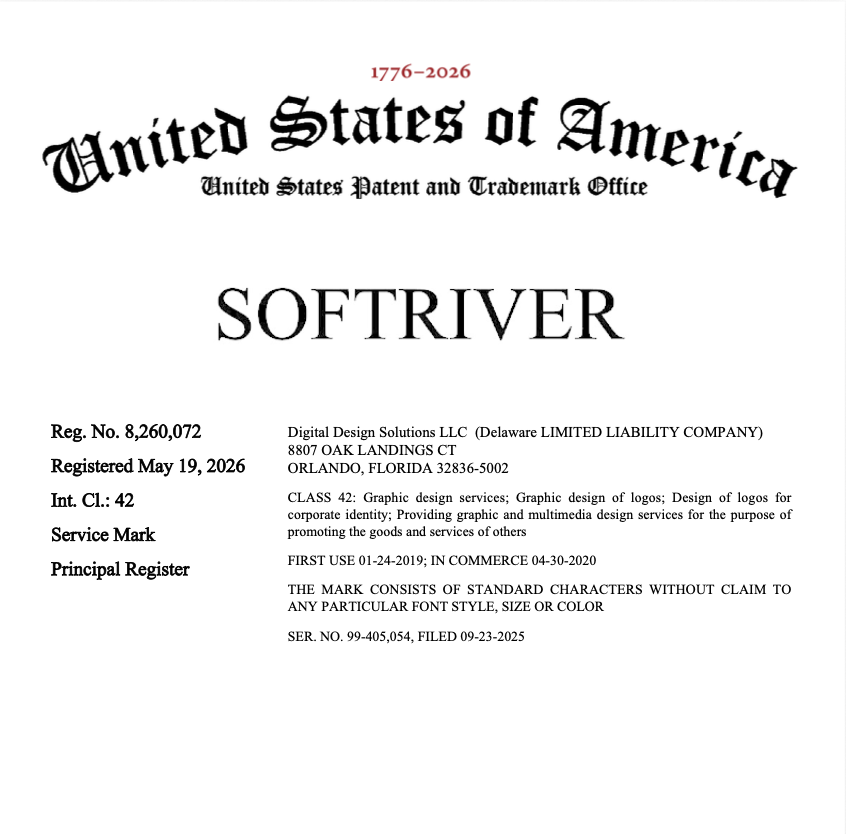
We know what federal registration means because we have protected the Softriver name, too.
Your brand deserves the same clear path from search to registration — led by a licensed trademark attorney.
Timing
Most founders wait until they're making real money to think about trademark protection. By then, competitors have had months — sometimes years — to copy the name, and fixing that costs far more than preventing it.
Registering early costs less, moves faster, and gives you leverage from day one. You don't need your first million to protect what you're building. You need it protected before you get there.
Your Options
Cut-Rate Filing Services
Often just a form-filler — sometimes no licensed attorney at all.
Big Law Firms
A licensed attorney, usually behind a team of paralegals.
Our Firm
You, working directly with a licensed attorney. No hand-offs.
Cut-Rate Filing Services
Not backed by U.S.-licensed attorneys. Many prepare the application but don't file it — or file a sloppy one so you pay more to fix it later.
Big Law Firms
Often $3,000+, sometimes hourly, rarely itemized.
Our Firm
One flat fee, shown before you pay anything: $987.
Cut-Rate Filing Services
Extra fee, if they can even help. Many can't.
Big Law Firms
Often billed separately, sometimes without warning.
Our Firm
Included in your flat fee. No surprise invoice.
Cut-Rate Filing Services
Usually a quick database check, not a real legal opinion.
Big Law Firms
Thorough, but priced and explained separately.
Our Firm
A real clearance search and a plain-English opinion, before you file.
Cut-Rate Filing Services
A support ticket, if anyone.
Big Law Firms
A case manager, then eventually the attorney.
Our Firm
Your attorney. Every time.
The part no one tells you
Selling under a name gives you some rights where you sell. Without a federal registration, that's a brand built on a handshake. If a copycat is already causing confusion, you may have grounds to send a demand letter. That's not step one.
Contacting an infringer before you file is the real risk. If they reach the USPTO first, your claim generally turns into an expensive lawsuit instead of a straightforward application. Search, then file, then send the letter.
Some names are too weak to register at all — anything that just describes what you sell. A quick DIY search rarely tells you which kind you have.
Someone starts selling under a name close to yours. Without registration, you can't use ® to warn them off. You have very little leverage to make them stop.
Brand Registry requires an active or pending trademark. No mark means no protected listings, no A+ content, no Sponsored Brands.
A cease-and-desist arrives. Legal defense alone can run $5,000–$100,000+. Losing means a new logo, site, packaging, and ads — easily $10,000+ and months of confused customers.
Fees & Process
You know the cost of the search, the filing, and the follow-through before any work starts.
Direct communication throughout. No hand-offs to a case manager.
Real USPTO wait times, stated plainly. Not a marketing promise.
You know in advance what an Office Action response costs, if one is needed.
No radio silence between USPTO actions.
Why cheap filing fails
Discount sites run your name through a database and hit submit. Most refusals come from two things that check can't catch: a name too close to one already registered, or a name that just describes what you sell. A form doesn't know the difference. An attorney does.
An attorney searches federal, state, and common-law names by hand — not just an algorithm. You get a plain-English risk report before you spend a dollar filing.
We draft the classification, description, and proof-of-use strategy to hold up under examination. Not just to get submitted.
If the USPTO pushes back, we respond. If a copycat appears in year one, our watch service flags them. You're not left alone after submission.
Trademark Prosecution
An attorney searches by hand and gives you a plain-English risk report before you file.
We draft the application to survive examination — classification, description, and proof of use.
If the USPTO pushes back, we write the response.
If everything goes smoothly, registration usually lands in about 1 to 1.5 years. Then you can drop the TM and use ®.
The Offer
$987 flat attorney fee + USPTO filing fee ($350/class) — one flat invoice, ever.
Cease & Desist Letters

A copycat showed up. An attorney-drafted letter is often the fastest way to stop them without going to court. MarkSentinel reviews the use, confirms your rights, and sends the letter on attorney letterhead.

Sending a demand letter before your own application is filed can weaken your position. File first, then enforce.
Clients We've Assisted




What Our Clients Say
I hired Softriver Legal to file my trademark in the United States (via the USPTO), and honestly, it was impeccable from start to finish.
Ultra-responsive communication, a smooth process, and zero hassle. Everything was wrapped up in just a few exchanges. It's rare to come across a legal service that is both this efficient and pleasant to work with.
I recommend them 100%.
Kylian
Founder of taap.it
Date of experience: January 15, 2026
I had a great experience working with the Softriver Legal team. The entire process was very clear and seamless, making it easy to secure my brand without dealing with confusing or unnecessary administrative steps.
Everything went smoothly from start to finish, and overall it was a great experience. I'd definitely recommend Softriver Legal to anyone looking for a straightforward way to protect their brand.
Alexandros Kokkotas
Graphic & Industrial Designer
Date of experience: October 26, 2025
Subject manner expertise and In depth expertise was important to decision-making. Their advice and research were well-communicated and exactly what the team needed. Would definitely engage in future projects requiring trademark expertise.
melinda_m2i
United States
Date of experience: June 2026
Absolutely superb experience and you should hire Softriver Legal for any trademark needs.
crescitecullen
United States
Date of experience: March 2026
Fast and accurate trademark application submission.
neuralopslabllc
United States
Date of experience: December 2025
Trademark Basics
Most businesses build a name for years before asking whether it's actually theirs. Registration turns “we've been using this” into a right you can enforce.
An application locks in your priority date the day it's submitted. You can file before your first sale, based on intent to use. Waiting doesn't hold your place — it gives someone else the chance to take it.
A federal registration protects your name nationwide, even if you sell in one city today. That matters the moment you expand to a new state, a new market, or online.
Without registration, you prove your rights state by state, with evidence. A federal registration is generally presumed valid and nationwide. In a dispute, that puts the burden on them.
This is the most common misunderstanding we hear. Both are state paperwork. Neither creates trademark rights, and neither stops someone else from registering a similar name.
Trademark rights are private. The USPTO registers marks — it doesn't send demand letters for you. A nationwide presumption of ownership is a much stronger starting point than assembling proof from scratch.
Anyone can use TM. ® is only for federally registered marks. Using it early isn't a style choice — it's a misrepresentation with real consequences.
Registration isn't a formality. It's the difference between a name you use and a name you own.
This is general information, not legal advice. Your facts can change any of these outcomes.
Questions
No. You can file based on a genuine intent to use the name, before you sell anything. Waiting doesn't protect you — filing does.
No. An LLC is a tax and liability structure, not a trademark. It doesn't stop someone else from using or registering a similar name.
Anyone can use TM — it just means you believe you have rights. ® is reserved for names that are actually federally registered. Using it before that isn't a style choice, it's a real problem.
Almost certainly a scam. The USPTO never calls, texts, or demands urgent payment. Check your application status yourself on USPTO's TSDR system, and never pay based on a cold call.
Yes. A federal registration covers the whole country from day one, even if you're only operating locally today — which matters the moment you grow.
No. Trademark rights are country by country. A U.S. registration protects you in the U.S. only — international protection needs separate filings.
It's common, and usually not the end of the road. Most rejections (called Office Actions) can be answered with the right legal argument or evidence.
For most businesses, the name matters most — people search for your name, not your logo. Registering the logo too is often optional.
Look them up directly in their state bar's public attorney directory. Never just trust a name and license number typed on a website or marketplace profile.
Not automatically. Someone may still legally own that name even after a company closes. Always check before using a name that used to belong to someone else.
Expect about a week between major updates — a legal opinion, a filing confirmation, or a request for more information. Busy periods can stretch that to two weeks. We email you proof of filing once your application is submitted.
Need it filed right away? Add expedited filing for $150 on the form.
The USPTO generally takes about 4 to 5 months for a first response. Current USPTO wait times are here. If everything goes smoothly, registration usually lands in about 1 to 1.5 years. That's when you can switch from TM to ®.
Basic information only. No business formation documents or sales invoices are required. Our form asks for everything we need: the name, logo, or slogan, your goods or services, and your mailing address. If anything else comes up, we'll ask.
Yes. A maintenance filing is due between the 5th and 6th year after registration. A renewal is due between the 9th and 10th year.
Cost depends on your number of classes and your filing basis. Email us for a quote.
We try to remind you, but these deadlines are years out, so we can't guarantee it.
Yes. With a U.S.-licensed attorney representing you, a foreign home or business address is fine. You can file as an individual or a business. No extra cost or paperwork.
Using a foreign application or registration as your filing basis costs an extra $50 per class, because the goods and services wording has to be adapted to the U.S. Trademark Identification Manual. We invoice that separately after you submit the form.
Either works. Filing under a business entity means you won't have to reassign the trademark if you sell the business.
It also keeps your personal details out of public search results. Websites crawl the USPTO database, so individual filers often see their name, mailing address, and country of citizenship show up on Google.
A flat $800 to draft and file a response that requires legal argument — for example, a refusal based on a likelihood of confusion, meaning your name is too close to one already registered. This price applies when we take over an application you already filed.
Two applications are required. For the same brand, we charge an extra $390 professional fee plus the extra $350 filing fee — $740 more in total for one class.
For most businesses, register the plain-text name first, as its own application. The logo is best handled separately.
You can file one application for a logo containing your name, but we don't recommend it. Redesign the logo later and you risk losing protection for the name.
Choose word, logo, or both on the form.
If you're already selling, we find your website or listing and take a screenshot ourselves. If we can't find it, we'll ask you for a photo of your product or advertising.
Not selling yet? We generally file on an intent-to-use basis. If the application succeeds, a follow-up statement of use is due months later, at $350 per class ($150 government fee plus our $200 fee).
If you're still not selling within six months of initial approval (a Notice of Allowance), you can get up to five six-month extensions, each a bit less than the statement-of-use fee.
These later fees cover deadline tracking, reminders, and specimen help months after filing. Already selling when we file? You won't pay them.
$500 per extra class — $350 to the USPTO, the rest for labor and payment processing.
We can usually tell from your goods and services list, or you can flag it in "Additional Notes." The form only charges for one class, so we invoice extras separately. We never file for multiple classes without asking you first.
See the list of 45 trademark classes.
Look up which class your goods or services fall into.
Most clients only need one class. U.S. protection is generally broad: own the name for pillows and bedsheets, and a competitor selling mattress toppers under your name is in serious trouble.
Generally, no — brand names belong in trademark law, not copyright. Logos are brand identifiers too, so register them as trademarks. You can copyright a logo, but it's far less useful than a trademark.

15 minutes. No obligation. Straight answer on whether your name is safe to register.